
Family History (1500s A.D.)
Table of Contents
- Countess Beatrix d’Entrmont
- Jacqueline de Montbel d’Entremont
- Gaspard II de Coligny
- Louise de Coligny
Countess Beatrix d’Entremont

Born in 1520, Countess Beatrix d’Entremont was a high ranking lady who came to France within the entourage of Eleonore of Castile. A young Spanish woman of Portuguese descent, Beatrix’s father was Count Jean of Sifuente and Duke of Ascalana. She lived in the Louvre Palace with Queen Eleanor of Austria after Eleanor’s marriage to Francis I of France, as one of her ladies in waiting, alongside other famous courtiers such as Diane de Poitiers. She married Lord Sebastien, count of Entremont and Montbel, Lord of Montellier, Natage, and Saint-Maurice on September 17th, 1539, in the presence of the Dauphin (the future Henry II of France).
They birthed an only daughter, Jacqueline, in Paris on February 16th, 1541. In 1547, she moved from the Louvre to the Spanish Netherlands after Eleanor’s husband, Francis I of France died ,and the Queen brought her ladies in waiting with her, which included Beatrix, where she lived in the Chateau de Saint-Andre at Briord in Bugey. Later, she belonged to the court of Catherine de Medici, when this portrait was painted of her by Francois Clouet in 1550, who was renowned for doing many portraits of the Medici family. In this portrait she is about 30 years of age, adorned in jewels draped over her shoulders, wearing a beautiful black dress enhanced with deep red and gold bands, and with a graceful, delicate smile. She was an inspiration for many artists, such as the painter Corneille de Lyon, and the poet Marc-Claude de Buttet. Buttet even dedicated Beatrix as his muse, giving her the alter-ego of “Amalthea”, a name attributed in Grecian mythology to Zeus’ foster mother, known as a ‘tender goddess’, or ‘nurturing goddess’.
Jacqueline de Montbel d’Entremont
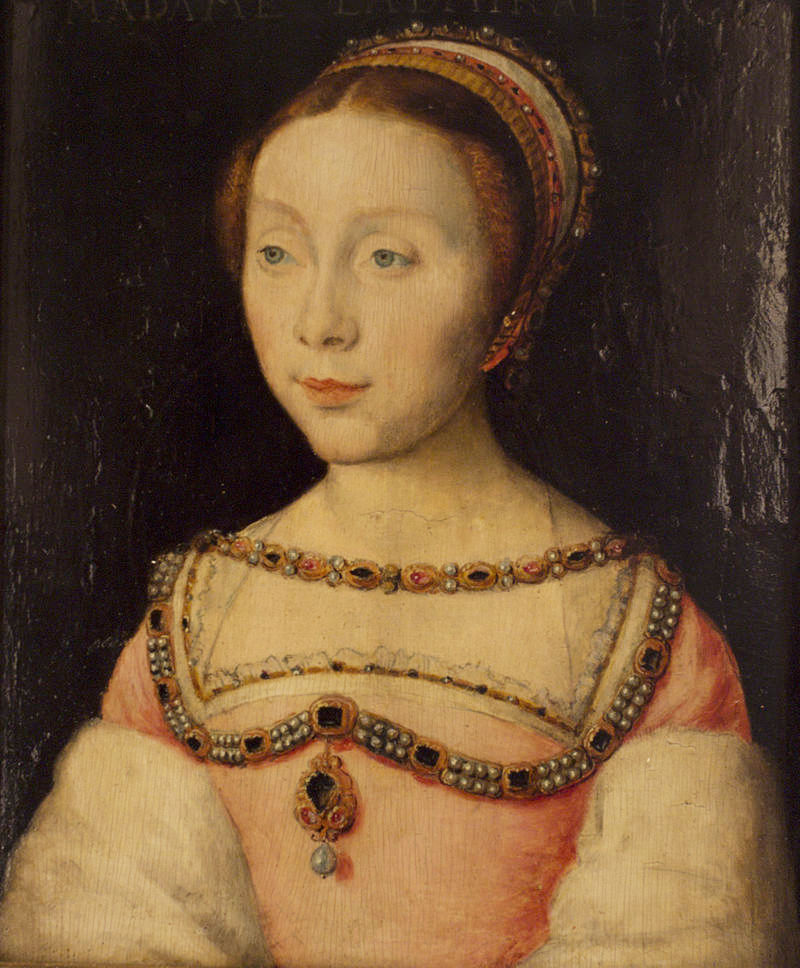
Jacqueline was the only daughter and sole heir to the Montbel d’Entremont family, which held several fiefdoms in Savoy, Bresse, Bugey, and Piedmont.
Her mother was Countess Beatrix d’Entremont, her father was Count Jean of Sifuente and Duke of Ascalana. She grew up in the Louvre for 6 years, where her mother was a maid of honor to Queen Eleanor of Austria. When Queen Eleanor took refuge in the Spanish Netherlands in 1547, Jacqueline went with her mother to the Chateau de Saint-André at Briord in Bugey. She remained in the royal court in Brussels until age sixteen, where she was then chosen to be a maid of honor to princess Marguerite of France, where she returned to the Louvre.
Montbel Family Possessions
- Castle Montbel
This ancient castle depended on the lords of Montbel. It was occupied by a castellan, lieutenant of the lord, in charge of supervising the ancient paths leading to the Col de la Crusille and also in the distance, the valley of the Guiers and the Aiguebelette lake basin. It was indeed a good lookout post due to its location on this eminence
rocky from where the view extended in the direction of the castle of Gerbaix and that of St-Maurice-de-Rotherens.
- Château d’Entremont
The Château d’Entremont was a castle from the 10th century, the residence of the lords of Montbel and the center of the seigniory of Entremont, which stood in the commune of Saint-Pierre-d’Entremont in the department of Savoie in the Auvergne-Rhône-Alpes region of France.
- Old Castle of l’Epine
Founded by William Montbel d’Entremont, he created a chapel to deposit the reliquary of the Holy Thorn (identical to that possessed by the Holy Chapel of Paris) brought back from the Seventh Crusade. An important pilgrimage took place each year in Nance to honor this relic.
- Castle Dullin
- Castle of Saint-Pierre d’Entremont
- Château du Montellier in Montellier
- Château de Saint-André in Briord
- Touvet Castle
- Castle of Verel-de-Montbel, in Verel-de-Montbel
First Marriage
In 1557, The Duke of Savoy had defeated the French at the battle of Saint-Quentin in 1557, and with the many changes he installed, he presented a condition upon Jacqueline: “when she reaches marriageable age, Jacquline must marry a Savoyard lord of identical rank and of Catholic religion. The safety of the States of Savoy is at stake.” The tensions between Protestants and Catholics ceased when Henry II of France died of wounds due to a jousting match organized in honor of Marguerite’s marriage to Emmanuel-Philibert, Duke of Savoy. Plans for Jacqueline’s marriage to a French lord were in order, despite the fact she was told she would marry a Savoyard. Her mother, Beatrix, favored Claude de Bastarnay, who was the nephew of Diane de Poitiers, whom she had worked alongside as a lady in waiting for Eleanor.
In the Histoire de la Bresse et du Bugey, Samuel Guichenon states: “The marriage had great difficulty in succeeding, since, as the countess Jacqueline was extraordinarily rich and powerful in estates – the Duke of Savoy, her natural prince, wished her to marry one of his lords. However king Charles IX having written in favor of the comte du Bouchage, their marriage took place on February 16th, 1561”
Jacqueline was quite lonely, as Basternay was away fighting as a Catholic in the Wars of Religion, and due to this fact, she never bore any children. He was evidently killed at the Battle of Saint-Denis, where Protestant forces were led by her soon to be husband, Gaspard II de Coligny.
Second Marriage
After these wars, Jacqueline took refuge with her mother in Briord, where she met the Savoy poet Marc-Claude de Buttet, whom she previously knew when she stayed at the Louvre. Previously, her mother was Buttet’s muse, with the alter-ego Amalthea, the nurturing goddess, but now, he chose Jacqueline as his muse, and she took over the pseudonym. She had also met Theodore de Beze, part of a brigade of poets that Buttet was also a part of. He had converted her mother, Beatrix, to Protestantism, and additionally a friend of Gaspard II de Coligny, leader of the French Protestants, and a establisher of Huguenot colonies. On March 3rd, 1568, Coligny’s wife Charlotte de Laval died, and following suit, Beze advised Jacqueline to marry Coligny – after all, she had known him previously, meeting him several times at the Louvre.

Though Coligny was unenthusiastic about the match, entirely due to his self consciousness about his major wound he received in the battle of Moncontour (a shot in the face), and their 23 year age difference, he received a letter from Beze stating:
“Madame d’Entremont is a lady endowed with virtues and God’s rarest gifts, and is one of the richest jewels of the land in which she lives”.
This thoroughly convinced Coligny, and on March 25th, 1571, Jacqueline set off in deep secrecy across France with a small escort, and signed her marriage contract in the house of Francois III, count of La Rochefoucauld. This took place in the presence of Jeanne d’Albret, Henry of Navarre, Francois de Bourbon-Conti, and Louis of Nassau. Jacqueline loved Coligny most truly, and it is said of her, “She was uniquely sensible of Coligny’s merit, and had resolved to sacrifice the most shining fortune for the sake of having him as her husband”.
Living in safety at the Chateau de Chatillon-Coligny, Jacqueline was four months pregnant. Multiple threats were made upon the family, as Gaspard was blamed for the death of Francis, Duke of Guise. On August 22nd, 1572, an assasination attempt was made upon him, by a man called Maurevert from a house belonging to the Duke of Guise. The bullets tore a finger from his right hand and shattered his left elbow. Then, late on the night of August 24th, 1572, St. Bartholomew’s Day Massacre began, and Coligny was one of the first of its 5,000 victims in Paris – there were about 10,000 victims in Provence. He was attacked in his current lodgings led by a group by Guise. A man by the name of Charles Danowitz plunged a sword through Coligny’s breast and threw his body out of a window, to the feet of the new Duke of Guise. Still not dead, another one of the Duke’s associates chopped off his head. The day before the attack, he had penned the last letter of his life to Jacqueline:
“My Mie, I write you this letter to warn you that the wedding of Milady, the king’s sister, took place today… If I only regarded my contentment, I would be better pleased to come see you than to stay at court for many reasons I will tell you… Several small peculiarities have occurred that I have omitted to tell you but which I shall tell you in person… And yet I pray that Our Lord will have in his hold guard you, my daughter, my sister.”
She was now a widow, and she went by the titles of Madame l’Amirale de Coligny. Though suffering many sad fates of her husbands, she was now left with the many children from Coligny’s first marriage to tend and look after. She sent her eldest, Francis and Odet, to secure safety in Switzerland under heavy guard – she would have sent Charles, who had been 8, but he was too young to be able to join them. The day after the massacre, the king’s knights arrested Charles and he grew up in the royal court.
Jacqueline also took Nicolas Mius and Jeanne Mius de Meuillon’s children, and adopted them, as Nicolas Mius was murdered along with Gaspard in the massacre. She took Claude Antoine Mius, and sent him to her mother, Beatrix, to raise in her care. She then sent Nicolas’s daughters Charlotte Mius d’Entremont and Louyse Mius d’Entremont into the care of her stepdaughter Louise de Coligny, Princess of Orange, who was to raise them. After all of this, Jacqueline then signed documents to which all of Nicolas Mius’ descendents, regardless male or female, would carry the name and coat of arms of Count d’Entremont – her father. Jacqueline was exiled from France by Catherine de Medici, and calvarymen accompanied her, her stepdaughter, and her servants back to chateau de Saint-Andre at Briord, where Beatrix, her mother, awaited them. She was then back under the rule of the Duke of Savoy.
On December 21st, 1572, Jacqueline gave birth to a daughter and named her Beatrice after her mother. Conditions were placed upon her to have a return to Savoy – she must convert to Catholicism, and her newborn daughter must be baptized under Catholicism as well. The baptism took place in absolute secrecy in a parish church in Briord, with the presence of a few servants and her grandmother. As Jacqueline was absolutely exhausted by this birth, she entrusted her daughter to a wet nurse under the supervision of her mother.
Though her daughter was baptized as a Catholic, Jacqueline held strong belief she would continue to worship as a Protestant. She had kept correspondence with Protestants in Basel, and received ambassadors from Geneva. On January 15th, 1573, she commanded the polemicist Francois Hotman, to write a biography that glorified Coligny. All of this was risking the fiefdoms of Montbel on Savoy’s frontier, such as if Jacqueline were to marry a third time, thus the Duke of Savoy proposed that she come to court in Turn in clarify the situation. Previously being a maid of honor to the duke’s wife, Margaret, who was a secret supporter of the Protestants, she was incredibly won over by this proposal.
On February 22nd, 1573, Jacqueline and her Savoyard escorts traveled as far as col du Mont-Cenis, where by surprise, the Duke was awaiting them at Nice. She rerouted, met him there, and was guarded by twelve Piedmontese archers who were commanded by Andre Provana de Leyni. At her arrival, she was imprisoned in the fortress at Nice on March 8th, 1573. Her imprisonment sparked outrage, and many, including her mother, sent ambassadors to try and appeal her case. A notable case was made by her nephew, Henri, Prince of Conde, who stated:
“If you take pity on my aunt … and wish to free her from captivity and the prison in which she is so strictly detained and return all her lands and her full liberty, you can be assured of receiving this thanks, that she shall bear herself with such modesty in subjection and obedience as she must, that you shall have no other occasion to complain of her.”
No matter how many cases were made, the Duke stood his ground and insisted that she convert to Catholicism and resume her devotion and loyalty to him.
Even after all of this, Jacqueline refused to renounce her Protestant beliefs, insisted on by forms sent by the Duke and Catholic hierarchy. When Margaret died in Turin on September 15th, 1574, she had lost a major supporter – after her death, Jacqueline ultimately renounced Calvinism on April 7th, 1575, with the bishop of Nice, Francois de Lambert receiving her back into Catholic faith. She then signed an agreement at Nice on the 1st of May, 1575, that committed her to house arrest after two years and three months’ imprisonment.
The Final Years

Between the years 1575 and 1594, Jacqueline was accepted back into the court in Turin and resumed her title as official dowager countess of Montbel d’Entremont. She took part in all of the festivities there, and gave birth to an illegitimate daughter in great secrecy in February 1578. She named the child Marguerite, after Margaret, the late duchess of Savoy. The father was the Duke of Savoy, and the child was then adopted by the countess of None, Cassandre.
On August 30th, 1580, the Duke of Savoy passed away. Festivities and intrigues continued at the ducal court in Turin, and Jacqueline was suspected of secretly negotiating with Henry IV of France, after his conversion to Catholicism on February 27th, 1594. Jacqueline’s illegitimate daughter Marguerite was suspected of being possessed by a demon, which led accusers to say that Jacqueline was involved in witchcraft.
She was then imprisoned in the Moncalieri fortress in Turin, and though she was cleared of sorcery, she was kept imprisoned based on new charges of treason. A few years later, on April 17th, 1598, she was transferred to the prison at Ivrea. Henry IV had sent a letter in her favor on June 30th, 1598, instructing his ambassador Guillaume de Gadagne, lord of Boutheon:
“…Help me cousin, the wife of the Admiral of Castillon, who is treated very strictly by her officers, for no reason other than for always being very helpful in assisting my affairs. She had been accused of sorcery and had been treated badly before, having been transported from the cruel prison of the Chateau de Montcallier to a crueler one, the Castle of Ivrea, where it is not lawful for her daughter to see her, write to her, or receive news of her, and this only for having helped in my service without committing any felony against the said duke, as you will tell him, begging him, to have her delivered for my sake, and henceforth to live as a good neighbor and friend, as he wrote to me in a letter which the said Lullin presented to me.”
However strong this letter was, she remained in prison until her death. She was to have received the Catholic last rites, but no one knows where she is buried.
Gaspard II de Coligny

Gaspard de Coligny, born on February 16th, 1572, was a French nobleman and Admiral of France. He came from a noble family of Burgundy, and his family traced their descent from the 11th century. In the reign of Louis XI, they were in service to the King of France. Gaspard’s father, Gaspard I de Coligny, served in the Italian Wars from 1494 to 1516.
He came to court at the age of 22 and immediately began distinguishing himself, taking part in the sieves of Montmedy and Bains, although getting wounded. In 1544 he served in the Italian campaigns under the Count of Enghien, and was knighted on the Field of Ceresole. He exhibited great intelligence and had calculated strategies, thus he took part in many different military operations and was made colonel-general of the infantry in April 1547.
In the same year, he married Charlotte de Laval. On the death of Claude d’Annebaut, he was made admiral. In 1557 he was entrusted with the defense of Saint-Quentin, which was being besieged by a Spanish army that had come down from Flanders. He displayed great courage, boldness, and strength, however the place was taken over, and he was eventually imprisoned in the stronghold of L’Ecluse. On a ransom payment of 50,000 crowns he recovered his freedom.
By this point in time, Coligny has become a Huguenot, influenced by his brother, d’Andelot. John Calvin first addressed to him a letter on September 4th, 1558:
“We have indeed occasion to praise God for the singular courage which he has bestowed on us to serve his glory and the advancement of the kingdom of his Son. It was to be desired that you had many companions to aid you in your task, but though others are slow in acquitting themselves of their duty, nevertheless you put in practice the saying of our Lord, that each should follow cheerfully without looking upon others.”
Secretly focused on protecting his co-religionists, Caligny was attempting to establish colonies abroad where Huguenots could find refuge. He organized the expedition of a colony of Huguenots to Brazil, under the leadership of Vice-Admiral Nicolas Durand de Villegaignon – who established the colony of France Antarctique in Rio de Janeiro in 1555. However, they were eventually expelled by the Portuguese in 1567.
Along with the expedition, Coligny was also a leading patron for the failed French colony of Fort Caroline in Spanish Florida led by Jean Ribault in 1562.
In 1566 and 1570, Francisque and Andre d’Albaigne submitted projects to Coligny for establishing relations with the Austral lands. Although he gave favourable consideration to these initiatives, they came to nothing when Coligny was murdered in 1572 during the St. Bartholomew’s Day massacres.
Conflicts
Following the death of Henry II he placed himself at the forefront of the Huguenote party and demanded religious tolerance. In 1560, at the Assembly of Notables at Fontainebleau, hostility between Coligny and François of Huise erupted violently. When the civil wars arose in 1562, Coligny took up arms,
and remained always ready to negotiate. He did not show incredible intellect or military genius during these times, but acted with great prudence and extraordinary tenacity, and people called him “le héros de la mauvaise fortune”, “the hero of misfortune”.
First War of 1562-63
Coligny commanded the cavalry at the Battle of Dreux, the first major engagement, and he avoided being captured, unlike both
of the commanders in chief. He was blamed for the assassination of Francis, Duke of Guise at Orléans in 1563.
Second War
In 1569, when Prince of Condé died at the Battle of Jarnac, he left Coligny the sole leader of the Protestant armies. Victorious at the Battle of La Roche-l’Abeille,but defeated in the Battle of Moncontour on October 3rd, he entered into the negotiations for what became the Peace of Saint-Germain (1570).
Marrying Jacqueline de Montbel d’Entremont, and returning to court in 1571, he grew rapidly in favor with Charles IX, becoming a close mentor to the weak, easily manipulated King.
Assassination and Massacre

Multiple threats were made upon the family, as Gaspard was blamed for the death of Francis, Duke of Guise. The wedding of the Protestant Henry, King of Navarre, and Marguerite de Valois, the King’s sister, brought a great number of Huguenot notables to Paris, and political and religious tensions were running extremely high.
On 22 August 1572, the day after the end of the wedding festivities, an assasination attempt was made upon him, by a man called Maurevert from a house belonging to the Duke of Guise. The bullets tore a finger from his right hand and shattered his left elbow. Then, late on the night of August 24th, 1572, St. Bartholomew’s Day Massacre began, and Coligny was one of the first of its 5,000 victims in Paris – there were about 10,000 victims in Provence. He was attacked in his current lodgings led by a group by Guise. A man by the name of Charles Danowitz plunged a sword through Coligny’s breast and threw his body out of a window, to the feet of the new Duke of Guise. Still not dead, another one of the Duke’s associates chopped off his head.
Gallery


Louise de Coligny

The daughter of Gaspard II de Coligny and Charlotte de Laval, Louise de Coligny was a Princess consort of Orange and a Huguenot.
She was born at Chatillon-sur-Loing and received a humanist style education. Louise married at age sixteen, to Protestant Charles de Teligny in 1571 – however, he was murdered at the St. Bartholomew’s Day Massacre along with her father.
